
URGENT MEMO: The Moon Is Filthy, Your Budget Is a Toothbrush, and Management Wants Results - MOON SWEEPERS
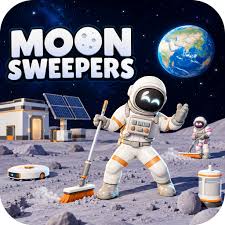
LUNAR SURFACE DEPARTMENT (LSD)
INTERNAL EMPLOYEE MEMORANDUM
Subject: Immediate Lunar Cleanup Operations
Equipment Provided: One toothbrush
Budget: Please do not ask
Mission: Clean the entire Moon.
Congratulations. Humanity has reached the Moon, planted its flags, conducted scientific research, and achieved extraordinary technological progress.
Unfortunately, nobody remembered to clean up afterward.
That is where you come in.
In Moon Sweepers, developed by DragDrop Games, players join an underfunded lunar cleanup operation tasked with collecting dust, delivering shipments, upgrading equipment, and gradually transforming a ridiculous cleaning assignment into a growing industrial operation.
You can work alone or recruit up to 15 other players. Either way, management expects results.
Welcome to the most ambitious janitorial operation in space.
1. Your First Day: Management Bought One Toothbrush
Most space exploration games begin with advanced technology, futuristic weapons, or a spacecraft capable of travelling across the galaxy.
Moon Sweepers begins with a toothbrush.
It is a wonderfully ridiculous introduction to the game's central joke. The Lunar Surface Department has an entire Moon to clean, but its equipment budget apparently disappeared somewhere between Earth and orbit.
Your first responsibility is collecting lunar dust manually.
At first, the work is slow and repetitive. You move across dusty terrain, brush the surface, and gather material that eventually becomes your first source of income.
But there is something satisfying about watching the environment change.
Every cleaning pass leaves a visible difference. Small patches gradually become larger cleaned areas, turning the Moon into a giant progress tracker.
The toothbrush may be an embarrassing starting point, but every operation needs to begin somewhere.
Unfortunately, your supervisor seems convinced that this entire planet-sized job can be completed with basic dental equipment.
2. Congratulations, You've Discovered Lunar Logistics
Cleaning the Moon is only half the job.
Once your storage fills with lunar dust, you need to transport it to a depot and launch shipments to receive payment.
That simple process creates the foundation of the game's progression system.
Collect dust, fill your storage, deliver it, receive money, and reinvest your earnings into better equipment.
As your operation expands, carrying capacity becomes increasingly important. Larger storage capacity means you can handle bigger collection sessions before returning to a depot.
You can also place depots closer to your working areas, reducing the distance between cleaning and delivery.
Suddenly, the game is no longer just about brushing dirt away.
It becomes a logistics operation involving collection routes, transportation, storage, and resource management.
Management may still call it cleaning, but anyone looking at your growing network of depots would probably describe it as an industrial enterprise.
3. The Promotion System: From Toothbrush Employee to Lunar CEO
Every employee wants a promotion.
In Moon Sweepers, the most convincing way to earn one is to invest your money into better cleaning equipment and larger operational capabilities.
As you progress, new tools improve the amount of dust you can collect. Additional carrying capacity makes each trip more productive, while vehicles introduce a different way to move around the lunar surface.
The change in scale is one of the game's most enjoyable elements.
You begin as a worker manually sweeping small patches of dust. Gradually, you become responsible for equipment, transportation, and increasingly large cleanup operations.
The progression feels rewarding because improvements have a visible impact on the work.
Areas that once required considerable effort can become easier to handle with upgraded equipment.
Your Moon also starts to look different as more of its surface becomes clean.
It is the unusual satisfaction of watching a workplace become more efficient while simultaneously watching an entire celestial body lose its dust.
Your job title may still say cleaner.
Your responsibilities are becoming considerably more ambitious.

4. The Office Has Robots Now, Because Apparently Humans Were Too Slow
At some point, management finally realizes that asking employees to clean an entire Moon manually is a questionable long-term strategy.
Enter J.O.O.N.A.S.
This automated cleaning robot represents another stage in the game's progression. It can clean lunar sectors and transport collected material toward nearby collection systems, allowing parts of the operation to continue with less direct player involvement.
Updates 1.0.4 and 1.0.5 also improved its navigation, cleaning behavior, and capsule delivery systems. <Cite refs={["turn259697view1"]}/>
The introduction of automation changes the feeling of the game.
You are no longer personally responsible for every square meter of lunar dust. Instead, you begin building an operation in which machines handle portions of the workload.
This creates a different kind of satisfaction.
You can watch your infrastructure expand, see robots working across the surface, and focus on developing the next part of your operation.
The toothbrush was the beginning.
The robot-powered cleanup department is the inevitable corporate future.
5. Sixteen Employees, One Moon, and Several Questionable Coworkers
Moon Sweepers supports online cooperative sessions with up to 16 players.
That means you can invite friends to divide the workload, clean separate areas, or work together on the same section of lunar terrain. <Cite refs={["turn576361view0","turn576361view2"]}/>
Cooperation adds another layer to the experience.
One player might focus on collecting dust, another may handle deliveries, while someone else spends time expanding infrastructure.
With a larger crew, the operation can become a shared project rather than a collection of individual tasks.
Of course, multiplayer also introduces the most unpredictable element of any workplace: coworkers.
One person might be extremely productive. Another may spend their time exploring instead of working. Someone else might be convinced that their latest construction project is essential, despite nobody understanding what it actually does.
That is part of the charm.
The Moon is enormous, the workload is ridiculous, and the team has enough room for both efficient cooperation and completely unnecessary distractions.
At least management cannot complain that nobody volunteered.
6. Building an Industrial Empire on an Extremely Dusty Moon
Eventually, cleaning becomes more than a manual job.
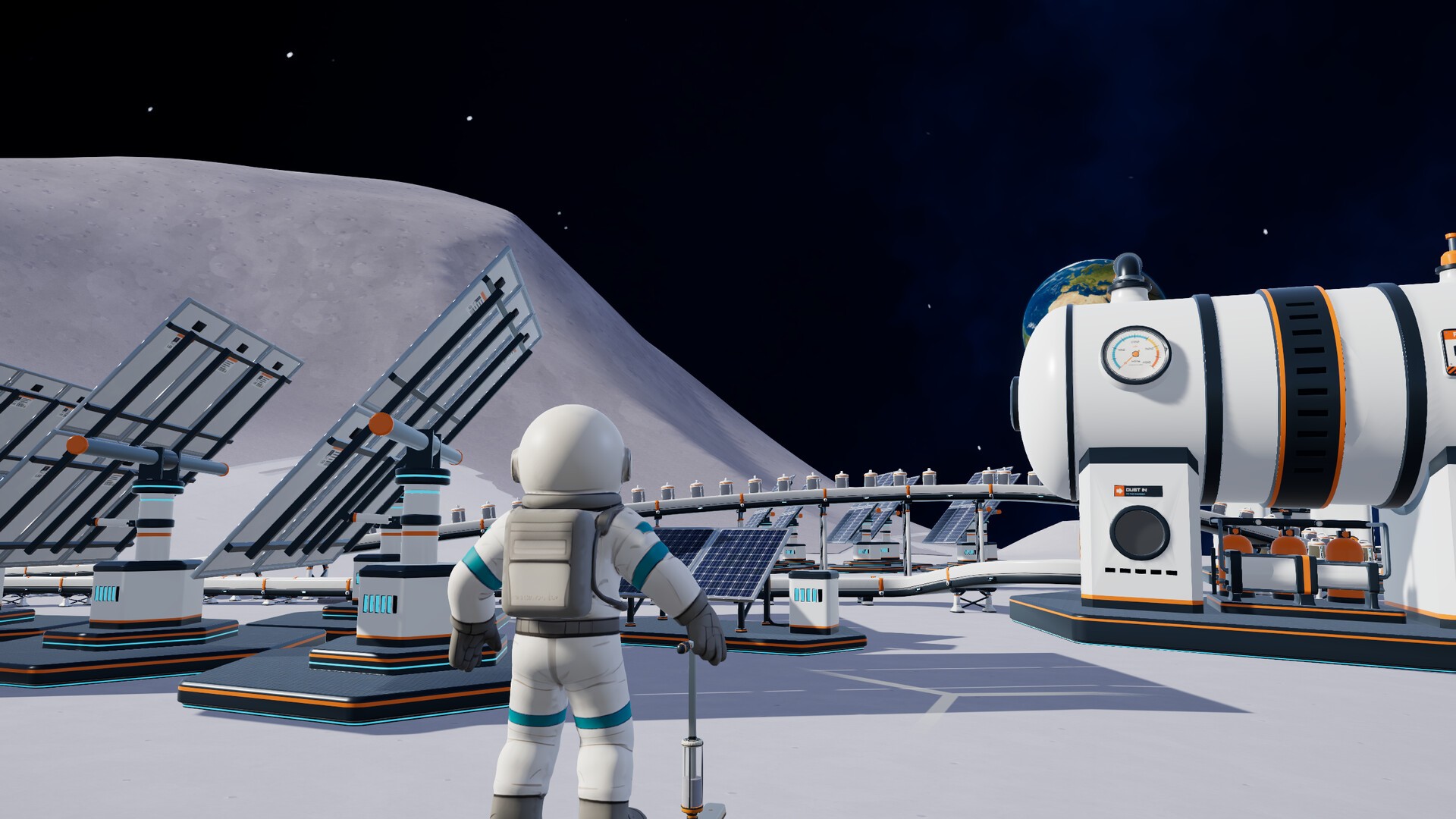
Your growing operation can include depots, buildings, cleaning vehicles, conveyors, and automated machinery. The construction system allows players to develop infrastructure around the areas they are working on.
This creates a transition from simple collection to a larger production environment.
Instead of personally handling every stage, players can connect different systems and expand their base as their needs change.
Update 1.0.5 also made construction more flexible, allowing structures to be moved, placed on different sides of foundations, and built directly on dusty ground. <Cite refs={["turn259697view1"]}/>
The more your operation grows, the more it resembles an industrial facility rather than a small cleaning team.
And the developer has already announced plans for a larger update 1.1 in December 2026, including additional production machines, materials, automation options, buildings, and progression. These features are planned content, not all currently available gameplay. <Cite refs={["turn576361view1"]}/>
Apparently, the Moon is going to need a much larger management department.
7. The Most Satisfying Promotion Is Watching the Moon Change
There is something unusual about Moon Sweepers compared with many conventional simulation games.
Your progress is not represented only by numbers, currency, or upgraded equipment.
It is visible in the environment.
The dusty surface gradually becomes cleaner. Your infrastructure expands. Vehicles and robots become part of the landscape. What once looked like an overwhelming cleanup assignment slowly turns into an organized operation.
That visual transformation gives the game a clear sense of accomplishment.
You can look back at an area that previously required manual cleaning and see how much work has been completed.
Every shipment, upgrade, and construction project contributes to a larger result.
And that result is surprisingly simple:
The Moon is getting cleaner because you and your crew actually did the work.

Conclusion: Management Has Approved Another Million Tons of Dust
Moon Sweepers turns an absurd premise into a satisfying combination of cleaning, progression, cooperative play, construction, and automation.
Its simple starting point—a toothbrush and an entire Moon—creates a clear sense of growth. Players collect lunar dust, deliver shipments, purchase better equipment, expand their infrastructure, and gradually introduce automated systems into the operation.
Playing with friends makes the experience even more entertaining, especially when the crew has different ideas about what productive work should look like.
What starts as a ridiculous cleaning assignment can eventually become a large-scale lunar enterprise.
There is no dramatic battle against an alien invasion. No ancient evil is waiting beneath the surface.
Just you, your crew, an unreasonable amount of dust, and a department that clearly needs to reconsider its equipment budget.
Now stop reading this memo.
The Moon is still dirty.